QUALITATIVE
ARITHMETHICS
AND VORTEX
MATHEMATICS

"If only you knew the magnificence of 3, 6 and 9, then you would have a key to the universe" (Nikola Tesla).

"Numbers are real and nature expresses itself with numbers" (Marko Rodin).


Qualitative Arithmetic

Qualitative arithmetic, also called "sacred" or "circular" −as opposed to traditional arithmetic which is quantitative, profane and linear− is a particular case of the so-called "clock arithmetic" or "modular arithmetic", invented by Gauss in 1801 in his book "Disquisitiones Aritmeticae".

In general, a number n in modular arithmetic is the remainder of dividing that number by the modulus m (remainder of n/m). For example, if the modulus is 12, the number 15 is 15−12=3, the number 33 is 33−12*2=9, the number 12 is 0 and 7+8 is 15−12=3. The formula to calculate the number n modulo m is: For example, In the case of qualitative arithmetic, the clock (or module) has 9 hours, and 0 is represented as 9.


Digital root of a positive number

Qualitative arithmetic is based on the concept of digital root, also called "mystic root", "quantum root" or "decimal parity".

The digital root of a positive number (integer or with a finite number of decimal places) is the sum of all its digits. If this sum is greater than 9, the digits are added again, and so on until a digit between 1 and 9 is obtained. Calling rd(r) to the "digital root" function of a number r, we have the examples: There is a direct way to calculate the digital root of a number r: For example, The number of additions that must be performed to a number r to obtain its digital root is called the "additive persistence" of r. Calling pa(r) the "additive persistence" function of r, we have: The additive persistence of a digit is zero: pa(5) = 0


Complementary digital root

The complementary, contrary, opposite, symmetric or dual root of a digit d (between 1 and 9) is 9−d. We will represent it as −d. By definition, the complement of 9 is 9 (its complement is the same). In the "clock" of modulo 9, the digits to the right of the 9 (1, 2, 3, 4) are positive (or of positive polarity), the digits to the left (5, 6, 7, 8) are negative (of negative polarity). Note that if a digit is even, its opposite is odd, and vice versa. The properties are satisfied:
Digital root of a negative number

The digital root of a negative digit is the 9's complement: The digital root of a negative number is the opposite of its digital root:
Properties
  1. The digital root of a digit between 1 and 9 is the same digit.
    ⟨( rd(n)=nn∈{1...9} )⟩

    rd(5) = 5


  2. ⟨( rd(r+9) = rd(r) )⟩
    rd(43+9) = rd(52) = 7 = rd(43)
    rd(45.3+9) = rd(54.3) = 3 = rd(45.3)


  3. ⟨( rd(r*9) = 9 )⟩
    rd(45*9) = rd(405) = 9
    rd(45.3*9) = rd(407.7) = rd(18) = 9


  4. ⟨( rd(r1+r2) = rd(rd(r1)+rd(r2)) )⟩
    rd(451+137) = rd(588) = rd(21) = 3
    rd(rd(rd(451)+rd(137)) = rd(10+11) = rd(21) = 3


  5. ⟨( rd(r1−r2) = rd(rd(r1)−rd(r2)) )⟩
    rd(451−137) = rd(314) = 8
    rd(rd(rd(451)−rd(137)) = rd(10−11) = rd(−1) = 9−1 = 8


  6. ⟨( rd(r1*r2) = rd(rd(r1)*rd(r2)) )⟩
    rd(45*13) = rd(585) = rd(18) = 9
    rd(rd(rd(45)*rd(13)) = rd(9*4) = rd(36) = 9


  7. ⟨( rd(10^n) = 1 )⟩

  8. ⟨( rd(r*(10^n)) = r )⟩

  9. The digital root of the difference between a whole number and the same number with the digits in reverse order is 9.

    ⟨( rd(n−inverse(n)) = 9 )⟩
    rd(531−135) = rd(396) = 9
    rd(135−531) = rd(−396) = −rd(396) = −9 = 9


  10. ⟨( (rd(n) ∈ {1 4 7}) → (rd(n*3) = 3) )⟩
    ⟨( (rd(n) ∈ {2 5 8}) → (rd(n*3) = 6) )⟩
    ⟨( (rd(n) ∈ {3 6 9}) → (rd(n*3) = 9) )⟩

    rd(127) = rd(10) = 1 rd(127*3) = rd(381) = 3
    rd(128) = rd(11) = 2 rd(128*3) = rd(384) = 6
    rd(129) = rd(12) = 3 rd(129*3) = rd(387) = 9


  11. ⟨( (rd(n) ∈ {1 4 7}) → (rd(n*6) = 6) )⟩
    ⟨( (rd(n) ∈ {2 5 8}) → (rd(n*6) = 3) )⟩
    ⟨( (rd(n) ∈ {3 6 9}) → (rd(n*6) = 9) )⟩

    rd(127) = rd(10) = 1 rd(127*6) = rd(762) = 6
    rd(128) = rd(11) = 2 rd(128*6) = rd(768) = 3
    rd(129) = rd(12) = 3 rd(129*6) = rd(774) = 9
These properties are the duals of the previous ones.


Remarks
Qualitative addition and subtraction tables

The first operand is the row. The second is the column. This criterion is the one for all tables.

+123456789
1234567891
2345678912
3456789123
4567891234
5678912345
6789123456
7891234567
8912345678
9123456789


123456789
1987654321
2198765432
3219876543
4321987654
5432198765
6543219876
7654321987
8765432198
9876543219

The subtraction table is really redundant, because
⟨( d1d2 = d1 + (−d2) )⟩,
which is equivalent to
⟨( d1d2 = d1 + (9 − d2) )⟩
For example, 4−7 = 4+2 = 6.

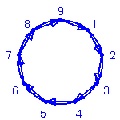
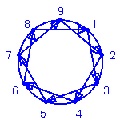
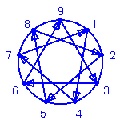
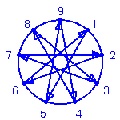
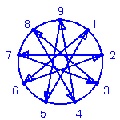
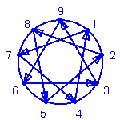
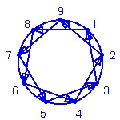
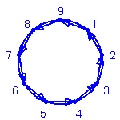
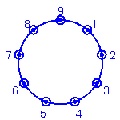
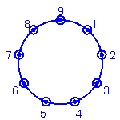
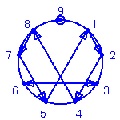
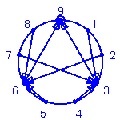
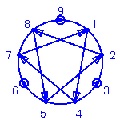
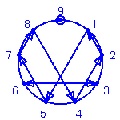
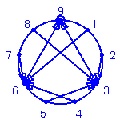
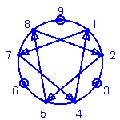
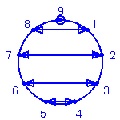
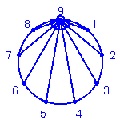
These tables can be represented graphically in a circle with the 9 vertices of an enneagon. The 9 is placed at the top vertex because it is the most important digit (it happens as with the 12 in the clock). An addition is made by going clockwise around the circle. The representations of the sums of (5, 6, 7, 8) are the duals of (4, 3, 2, 1), that is, the circle is traversed in the opposite direction.

Add 1
 
Add 2
Add 3
 
Add 4
Add 5
 
Add 6
Add 7
 
Add 8
Add 9

Qualitative multiplication table

*123456789
1123456789
2246813579
3369366369
4483726159
5516273849
6639639639
7753186429
8876543219
9999999999

The following properties can be observed in this table:
Multiply
by 1
 
Multiply
by 2
Multiply
by 3
 
Multiply
by 4
Multiply
by 5
 
Multiply
by 6
Multiply
by 7
 
Multiply
by 8
Multiply
by 9

Note that graphs 2 and 5, 4 and 7, 3 and 6, are dual, since they run in opposite directions.


Inverse of a digit

According to the table above, the pairs of inverses are (2, 5) and (4, 7). The inverse of 1 is 1. The inverse of 8 is 8. There are no inverses of 3, 6, and 9.

d123456789
d157248

Diagram of
inverses

Remarks: Examples:
  1. rd(1÷4) = rd(0.25) = 7
  2. rd(1÷8) = rd(0.125) = 8
  3. rd(124÷47) = rd(7÷11) = rd(7÷2) = rd(3.5) = 8
  4. rd(10÷8) = rd(1.25) = 8
  5. rd(100÷3) not defined

Qualitative power table

^123456789
1111111111
2248751248
3399999999
4471471471
5578421578
6699999999
7741741741
8818181818
9999999999

The following properties can be observed in this table:
The qualitative Fibonacci sequence

The Fibonacci sequence is an archetype of form, of spiral growth and divine proportion:

1, 1, 2, 3, 5, 8, 13, 21, 34, 55, 89, 144, 233, 377, 610, 987, 1597, 2584, 4181, 6765, 10946, 17711, 28657, 46368,...

where each element of the sequence is the sum of the previous two.

The sequence of the corresponding digital roots are:

1, 1, 2, 3, 5, 8, 4, 3, 7, 1, 8, 9 and their complements:
8, 8, 7, 6, 4, 1, 5, 6, 2, 8, 1, 9

An Australian mathematician of Indonesian origin named Jain de Mullumbimby [2002], discovered this cyclic qualitative pattern of 12×2=24 digits (12 principal + 12 complementary).
Digital roots of prime numbers

Below is the table of the first prime numbers with their corresponding digital roots. The digital roots of the prime numbers (except 3) are (1, 2, 4, 5, 7, 8), which are the only digits that have inverses. Neither 6 nor 9 appear.

2357111317 192329313741434753596167
2357248152415728574
717379838997101103107109113127131137139149151157163
8172872481515245741
167173179181191193197 199211223227229233239241251257263269
5281248147248578528
271277281283293307311 313317331337347349353359367373379383
1724515727457287415
389397401409419421431 433439443449457461463467479487491499
2154578172872482154
503509521523541547557 563569571577587593599601607613617619
8581178524128574157
631641643647653659661 673677683691701709719727733739743751
1248524728787874154
757761769773787797809 811821823827829839853857859863877881
1548458124822724848
883887907911919929937941947953967971977983991997
1572121528485217

Philosophy

Qualitative arithmetic motivates philosophical musings:
Vortex Mathematics

Vortex Based Mathematics, also called "Torsion Mathematics" is based on a discovery by Marko Rodin of two fundamental patterns of qualitative arithmetic:
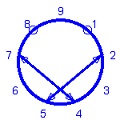
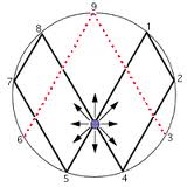
  1. A 6-digit pattern: (1, 2, 4, 8, 8, 7, 5) in the form of an infinity symbol.

    The two fundamental patterns
    of vortex mathematics.

    Starting with 1, and multiplying successively by 2, we obtain the numbers 1, 2, 4, 8, 16, 32, 64, 128, ..., which correspond to the digital roots 1, 2, 4, 8, 7, 5, 1, 2, 4, ..., that is, we have a cycle formed by 6 digits: (1, 2, 4, 8, 7, 5), which represented in the circle (or 9-hour clock) we obtain a symmetrical shape in the form of an infinite loop.

    If instead of multiplying by 2, we divide by 2, we have the numbers 1, 0.5, 0.25, 0.125, 0.0625, 0.03125,..... Their corresponding digital roots are (1, 5, 7, 8, 4, 2), that is, we go through the basic cycle in the opposite direction.

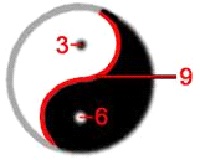
  2. A 3-digit pattern: (3, 6, 9) in the form of a triangle. Multiplying 3 by 2 gives 6. Multiplying 6 by 2 again yields 3. That is, 3 and 6 behave like a dipole, like a dual pattern or pendulum. Multiplying 9 by any number yields 9 again. 9 is an invariant.
Remarks:
The torus

Placing the sequence (6, 9, 3, 3, 9, 6) −(6, 9, 3) and its complementary (3, 9, 6)− between two copies of the sequence (1, 2, 4, 8, 7, 5), one in the positive direction and the other in the negative direction, we obtain:

578421
693396
124875

Joining these circular-shaped patterns together yields torus of different sizes. The smallest is a grid of 9×9. In the torus all the numbers are connected.

Rodin, inspired by the Baha'i faith, named the torus "ABHA", which means "the greatest name of God". Its pronunciation has two phases: AB (compression) and HA (decompression).
Rodin coil

From the torus came the Rodin coil. Rodin discovered that the cycle (1, 2, 4, 8, 7, 5) implemented as an electric coil achieved maximum energy efficiency in energy transformation. Already companies (such as Microsoft and HP) are using the Rodin coil. It is also being used by the U.S. government in highly sensitive antennas.


Rodin's reflections

Starting from the properties of qualitative arithmetic and its two basic patterns, Marko Rodin makes a series of philosophical reflections, some of them somewhat risky:

On vortex mathematics: About the torus: About the circle symbol and its outlines: About numbers: About 9: About the 3 and the 6:

Addenda

The Enneagram

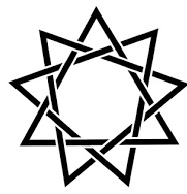
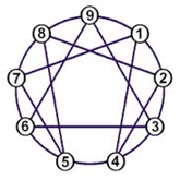
The vortex mathematics diagram bears some resemblance to the Enneagram. The Enneagram is an ancient sacred geometric symbol consisting of a circle with the vertices of a nonagon (numbered from 1 to 9, with 9 at the top), with an equilateral triangle joining the points (3, 6, 9) and interlaced lines corresponding to diagonals of order 2 and 3 of the polygon.

The Enneagram

The circle symbolizes the essential unity of all things. The vertices−numbers symbolize the 9 dimensions or archetypes of reality. The lines symbolize the relationships between the archetypes.

The Enneagram describes 9 distinct personality types and their interrelationships. Each personality type has associated patterns of thinking, feeling and behavior. It is also used as a method to know one's own nature, so that personality patterns are not automatic but conscious, and to develop higher states of being.

Gurdjieff claimed to have learned the secret of the Enneagram. According to the famous occultist, the Enneagram:
Some examples of manifestations of the number 9
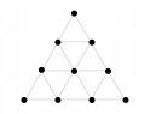
The Pythagorean Tetraktys

The Tetraktys is a triangular figure consisting of 10 points placed in four rows of 1, 2, 3 and 4 points, respectively. The Pythagoreans considered it a mystical, sacred structure, symbolizing the order, harmony and perfection of the universe, the symbol of universal manifestation, of cosmic discourse in the unfolding of its infinite possibilities.

The Pythagorean
Tetraktys

For the Pythagoreans, numbers constitute the essence of all things, but 10 was considered the most sacred number, for it symbolized totality, the source of the eternal and universal, the beginning of all things, the knowledge of oneself and of the world, as well as the return to unity. The 4 rows of the Tetraktys symbolize, respectively:
  1. The Unity (monad), the divine, the origin of all that exists, the unmanifest.

  2. The Dada, dualism, the unfolding of the Unity. It also symbolizes the feminine principle.

  3. The Triad, which transcends the opposites and participates in both Unity and duality. It also symbolizes the masculine principle.

  4. The Quaternary, which symbolizes harmony and the universe as manifestation in the 4 elements (earth, air, fire and water).
The set of all the above constitutes the Decade, the totality of the universe and the return to unity: 1+2+3+4 = 10 = 1+0 =1. The Tetraktys includes 9 triangles. Considering the central point as 0, we have 9 digits aligned on the sides of the triangle, as in qualitative arithmetic.


Vortex mathematics and Masonry

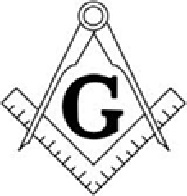
There is a certain analogy between the symbol of vortex mathematics and that of Freemasonry. In both cases it is to represent the union of opposites and of the two modes of consciousness: the rational and analytical with the intuitive and synthetic.

The symbol of
vortex mathematics

The Symbol of
Masonry

In vortex mathematics, the circular pattern (1, 2, 4, 8, 7, 5) corresponds to the HD (right hemisphere) of the brain. The bipolar pattern (3, 6, 9) corresponds to the HI (left hemisphere). In the Masonic symbol, the compass and the square correspond respectively to the HD and the HI. In both cases there is a center or intermediate space of transcendent type.


Vortitial mathematics and magic squares

Magic squares have the property that their rows, columns, and diagonals add up to the same quantity (the magic constant). The magic squares of vortex mathematics have more strength because they refer to the center, which is 9.

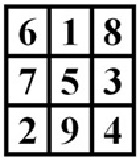
The Chinese magic square called "Luo Shu" is the oldest known magic square (circa 2000 BC). According to legend, it appeared on the shell of a turtle (with the numbers in the form of dots). It is of order 3 and magic constant 15, the simplest of all. The center is the number 5. The odd numbers (yang) are located in the middle of the sides, forming a cross, like the cardinal points. The even numbers (yin) are located at the corners, delimiting a square.

Magic Square
Luo Shu

This magic square is considered, among other things, a divine symbol, a good luck charm, a cosmogram of the order of the world, and a Feng Shui energy pattern (it matches the squares of the magic square with the rooms of a house, depending on the type of activity to be performed).


Bibliography